Workload-based selection
Choose model and service configurations against representative tasks. Compare answer quality, reasoning needs, response time and consumption.
PLATFORM / THE CONEXIQ INTELLIGENCE LAYER
Enterprise intelligence infrastructure connecting models, knowledge, tools and governance into an operational system—implemented within the organisation’s tenant and approved service boundaries.
MODULAR PLATFORM ARCHITECTURE
Three connected layers give agents a useful experience, a controlled route to enterprise knowledge and actions, and an accountable operating foundation.
INTERACTION LAYER
Capture structured or conversational intent in the employee’s existing work context. Establish the caller and maintain a consistent answer, evidence and status experience.
Interface: user request and authenticated context → response, references and operation status.
We design deployments around the client’s tenant and approved cloud resources, with scoped identities, permitted knowledge and tools, and an explicit record of data flows and service boundaries.
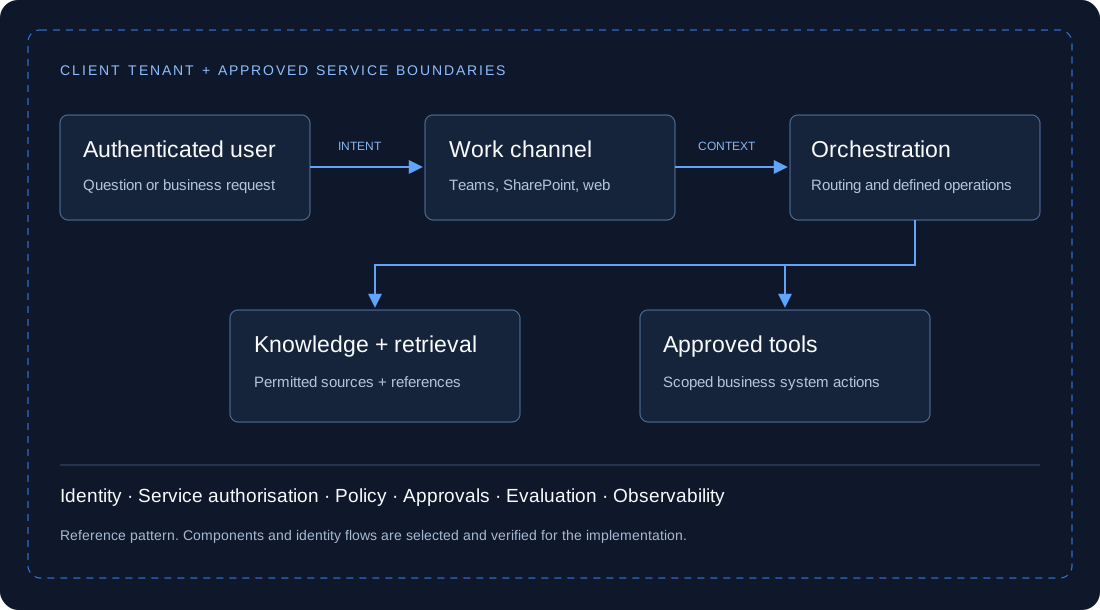
REFERENCE ARCHITECTURE
The experience connects to knowledge and tools through an explicit orchestration boundary. Identity and authority are established by the services responsible for each operation.
KNOWLEDGE AND GROUNDING
Establish authoritative sources, ownership and retrieval boundaries before a model forms an answer.
MODEL AND REASONING CONTROL
Select and configure models around the workload: quality, reasoning depth, latency, cost and the sensitivity of the business operation.
Choose model and service configurations against representative tasks. Compare answer quality, reasoning needs, response time and consumption.
Version prompt policies, system templates, retrieval configuration and tool contracts alongside the application release.
Define which decisions the system can support, where evidence is insufficient and when human review is required.
Design request limits, workload budgets, usage visibility and exception handling around the operating model.
AGENT ORCHESTRATION AND TOOLS
Agent routing, tool selection and workflow orchestration operate through defined interfaces and enforceable permissions.
GOVERNANCE CORE
Entra ID, Microsoft Graph and service-level authorisation establish the caller, the permitted context and the operations that may proceed.
Choose delegated access, application identities and managed identities deliberately. Test permitted and denied journeys under the relevant identity.
Translate agreed policy decisions into checks, approval responsibilities and exception paths at the service boundary.
Connect the request, approval, tool invocation and business result through correlation and structured run records.
EVALUATION AND CONTINUOUS ASSURANCE
Treat evaluation as part of the module lifecycle, including changes to knowledge, models, prompts and tools.
OPERATIONS AND OBSERVABILITY
Run-history and dataset retrieval, cross-system correlation, monitoring and diagnostic access connect technical activity to the business operation.
INTELLIGENCE FLOW
Each stage carries a defined responsibility through the operation.
Capture the user’s intent and relevant context.
Check identity, policy, knowledge scope and authority.
Orchestrate the permitted retrieval or approved operation.
Provide a useful response, references and traceable status.
LET’S BUILD THE NEXT CAPABILITY
Start with a reusable module, connect the relevant sources and tools, and deploy through the organisation’s enterprise controls.